 CimpactPRO Partner
Türkçeye Geç
CimpactPRO Partner
Türkçeye Geç
 Danışma Hattı
0 (850) 346 33 11
Danışma Hattı
0 (850) 346 33 11
 CimpactPro CORP
Corporate Carbon Footprint Calculation and Reporting Software.
CimpactPro CBAM
Border Carbon Regulatory Mechanism (CCRM) Declaration Software.
CimpactPro ESG
Sustainability / ESG Reporting and Management Software. (GRI)
CimpactPro CITY
Emissions Management and Reporting Software for Cities and Municipalities (GPC)
CimpactPro is a sustainability software family that covers all sectors with its modular structure developed by taking into account the specific needs of different sectors.
Explore All Sectors


With our mentoring, training and research-analysis packages, we build your capacity, finalize processes together and link your decisions to data-based, measurable results.
All Services
Accelerate standards compliance with weekly/monthly coaching and increase your teams' success in error-free implementation and on-time delivery.
Get Detailed Information
With hands-on sessions, it adapts standards and regulations to your corporate data; makes competence permanent and enables rapid implementation.
Get Detailed Information
Green maturity, awareness and GAP measurements link decisions to data and clarify the priority roadmap and KPIs.
Get Detailed InformationFrom technical guides to expert opinions, from analysis of current legislation to software support tools, CimpactPro Resources library has all the information you need to take firm steps towards your sustainability goals.









Kozyatağı Mah. İbrahim Ağa Sk. Som Plaza Kat:5 Kadıköy/İstanbul/TÜRKİYE
End Carbon Leakage with CBAM: New Era in Trade
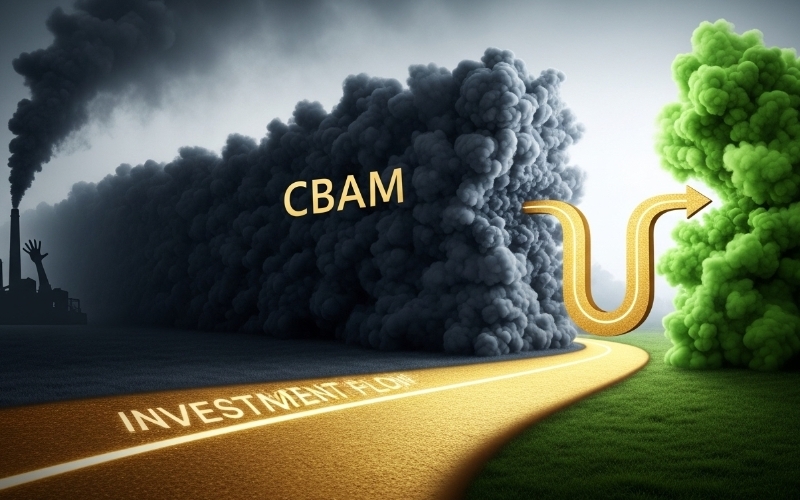








End Carbon Leakage: How CBAM Shapes Trade and Why It Makes Dirty Production Unsustainable
One of the biggest challenges of global climate policies is the phenomenon known as "carbon leakage". The European Union's strategic solution to this problem, the Border Carbon Adjustment Mechanism (CBAM), not only prevents this leakage, but also fundamentally changes the economic rules of global trade and production. But how does this mechanism work and why does it threaten the future of dirty manufacturing companies?
what is "carbon leakage" and how does CBAM solve this problem?
we can understand the concept of "carbon leakage" through an investor scenario. An investor who wants to start a business finds that if he invests in Europe, he will have to pay significant taxes through the Emissions Trading System (ETS). To avoid this additional cost, he shifts his investment to a country like Turkey, where there is no or lower emission tax. This is called "carbon leakage".
CBAM is designed to eliminate this injustice. The mechanism equalizes the tax on carbon emissions of a product produced in Turkey and imported to Europe with the tax on carbon emissions of the same product produced in Germany. In this way, the investor's main decision mechanism when choosing a factory location is not to avoid the emission tax, but other efficient parameters such as logistics and labor. CBAM prevents emissions from being the main determinant of investment decisions.
New Route of Trade and Investment
In this balancing role, CBAM is reshaping trade and investment decisions. An investor who previously planned to locate production in Turkey due to the tax advantage may now choose to invest again in an EU country such as Germany or Bulgaria as the tax burden is now equalized. This prevents carbon-intensive sectors from moving their investments outside Europe, helping the continent to develop locally and preserve its logistical advantages. In short, the era of firms "dodging" their environmental responsibilities by moving production abroad is over with CBAM.
The End of Dirty Production: Competitiveness and Future Threat
With CBAM, dirty production is no longer just a threat to the environment, but also to the economic future of companies themselves. The mechanism works like this: A company that produces pollution has to pay significant CBAM taxes due to its high emissions. These taxes increase the firm's costs, weakening its competitiveness against its rivals and making it no longer a sustainable business model.
At this point, a strategic decision moment arises for firms: Pay punitive taxes on an ongoing basis, or revise production and switch to cleaner production? The rational is to invest in clean production, which is easier and more profitable in the long run than paying fines.
CBAM as Preventive Treatment
The best analogy to explain this is the preventive medicine approach. It is always cheaper and more effective to prevent someone from getting cancer (for example, by stopping them from smoking) than to spend money treating them after they have cancer. This is exactly what CBAM tries to do. Instead of "treating" firms with heavy tax penalties, it acts as a "preventive" mechanism that encourages them to implement clean and healthy production models from the outset. This approach is the most sustainable path for both the environment and the long-term health of firms.